Pump Up The Volume
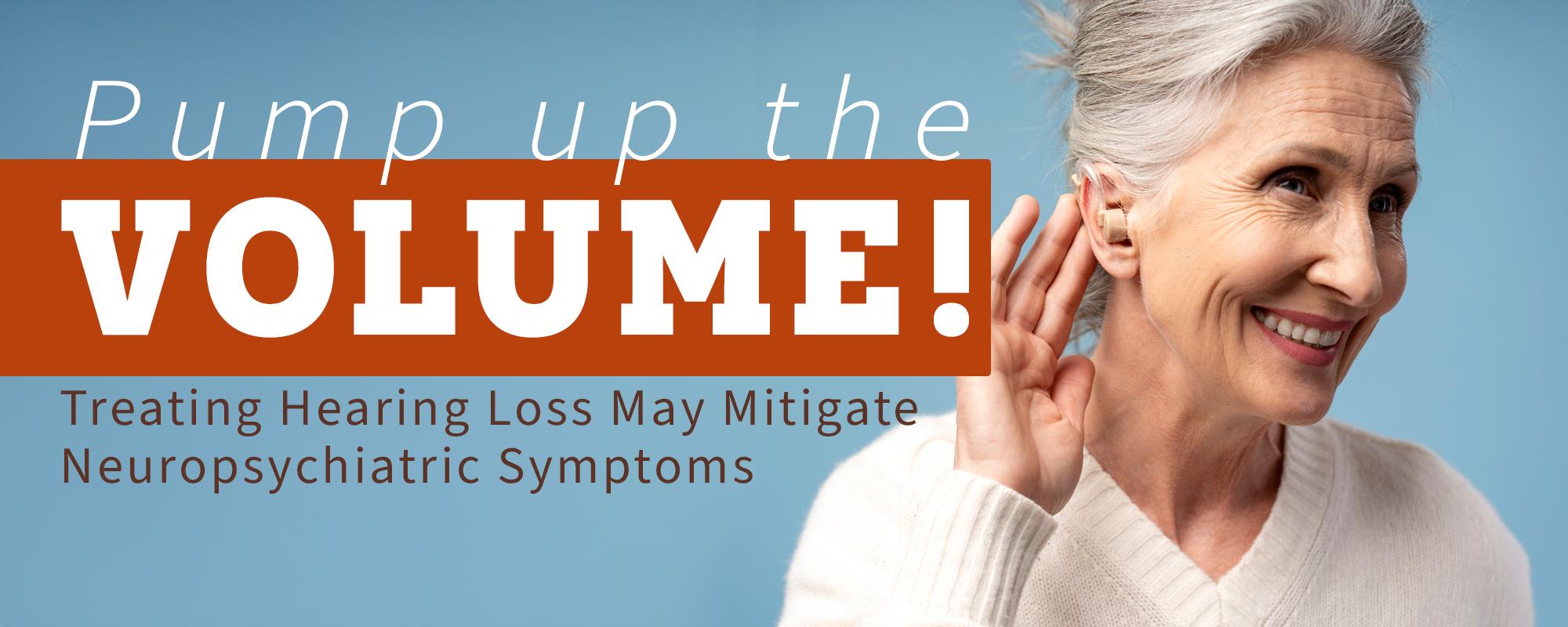
Using the NACC dataset, researchers at Johns Hopkins University and New York University have discovered that hearing aids may help reduce neuropsychiatric symptoms in people with both hearing loss and dementia. The work, published in the American Journal of Geriatric Psychiatry, underscores the importance of addressing hearing impairment in this patient population.

Previous studies have shown that almost 80% of people with dementia also have clinically significant hearing loss, and that figure rises to more than 90% for those over 85 years old. “Hearing loss among older adults is incredibly common, and that holds true for individuals with cognitive impairment as well,” says Carrie Nieman, MD, MPH, associate professor of otolaryngology and head and neck surgery at Johns Hopkins University and senior author on the new study.
Hearing loss can decrease quality of life, contribute to social isolation and stress, and may increase the risk for neuropsychiatric symptoms, which are themselves major causes of morbidity and mortality in people with dementia. Despite these strong correlations, though, hearing loss remains underdiagnosed and undertreated.
“There’s been a lot of attention in terms of thinking about if we do something about hearing loss, can we see anything in terms of slowing cognitive decline, that has been an area of interest in the past few years,” says Nieman. However, she adds that relatively few researchers have examined the effects of hearing problems in those who already have dementia.
Seeking to address that, she and her colleagues conducted a small study based on audiometric tests and neuropsychiatric screening of their own patients. That work showed that hearing loss correlated with more and worse neuropsychiatric symptoms in patients with dementia, and that those who used hearing aids suffered fewer symptoms. “But obviously that was one Center, only a hundred individuals, and so we wanted to at least explore [the correlations] at a broader scale,” says Nieman. The NACC dataset was an obvious place to turn. “Just being able to look across 10,000 individuals versus a hundred individuals [was] one of the main goals,” she says.
Analyzing the NACC data on self-reported or caregiver-reported hearing loss, neuropsychiatric symptoms, and hearing aid use, the team got two seemingly contradictory results. Surprisingly, and in contrast to their earlier results, hearing loss didn’t correlate with more or worse neuropsychiatric symptoms in people with dementia. However, among those who did report hearing loss, the subgroup that also used hearing aids had fewer neuropsychiatric symptoms. Taken at face value, the findings seem to suggest that hearing loss both does and doesn’t worsen neuropsychiatric symptoms in dementia.
The simplest explanation is that the negative finding in the overall population stems from a lack of sensitivity in the NACC dataset’s measurement of hearing loss. “In a perfect world, we would have had audiometric objective data on hearing status from 10,000 individuals, but that doesn’t exist, so the measure that exists within NACC is, ‘does the participant have functionally normal hearing?’” says Nieman.
That binary measure fails to capture the range of possible hearing impairments, and previous work has shown that people tend to under-report hearing problems. Indeed, by this qualitative measure, only about a quarter of the study’s sample participants reported functional hearing loss, which is much lower than expected based on the age of the cohort. “So, we have an indication that that’s an underestimation,” says Nieman. Such widespread under-reporting would have nullified any correlation that did occur.
While self-reporting may not be very sensitive, it is specific; people are unlikely to report hearing impairment if they don’t have it. That led the investigators to focus just on the subpopulation that did report functional hearing loss and asked whether addressing that with hearing aids correlated with better neuropsychiatric health. The analysis required a sophisticated statistical model to account for possible confounding factors. “The statistician on our team tried to create models that addressed potential differences between people who get hearing aids and those who don’t get hearing aids, like … finances or education or sex,” says Nieman.
Even after adjusting for those factors, though, the correlation remained strong; hearing aid use seemed to protect against neuropsychiatric symptoms. That result supports a model in which hearing impairment might contribute to the development of neuropsychiatric symptoms in people with dementia, and treating the impairment might prevent or mitigate those symptoms.
The clinical implications are clear. “We need to think about sensory health, we need to be thinking about hearing status for individuals who are aging with dementia and at least think about … trying to optimize things for those individuals,” says Nieman. She adds that with the availability of newer types of hearing aids, including over-the-counter hearing aids, such interventions are becoming easier and cheaper.
The findings from the NACC data and the team’s earlier results have already laid the groundwork for a new clinical trial. “We have a trial we’re actively recruiting for right now that is examining [whether we can] provide some practical hearing care intervention for individuals with cognitive impairment and hearing loss, and what do we see in terms of improvements or changes in neuropsychiatric symptoms,” says Nieman.
Shankar A, Garcia Morales EE, Leoutsakos JM, Cotter VT, Nowrangi MA, Yasar S, Lyketsos CG, Oh ES, Nieman CL. Hearing Loss, Hearing Aid Use, and Neuropsychiatric Symptoms Among Persons Living With Dementia: Findings From NACC. Am J Geriatr Psychiatry. 2025 Nov;33(11):1230-1239. doi: 10.1016/j.jagp.2025.07.007. Epub 2025 Aug 5. PMID: 40858488; PMCID: PMC12461887.