The National Institute on Aging/NIH currently funds 37 ADRCs across the United States. The Centers work to translate research advances into improved diagnosis and care and find ways to treat and possibly prevent Alzheimer's disease and related dementias. Each has its own research focus and recruitment protocol. However, the Centers are all required to involve their entire clinic enrollment in the Uniform Data Set (UDS) study and submit these data to NACC.
The Centers are organized into the following "cores" and "components":
- Administrative Core
- Clinical Core
- Data Management & Statistics Core
- Imaging; Neuropathology Core
- Outreach, Recruitment and Engagement Core
- Biomarker Core
- Research Education Component

Steering Committees
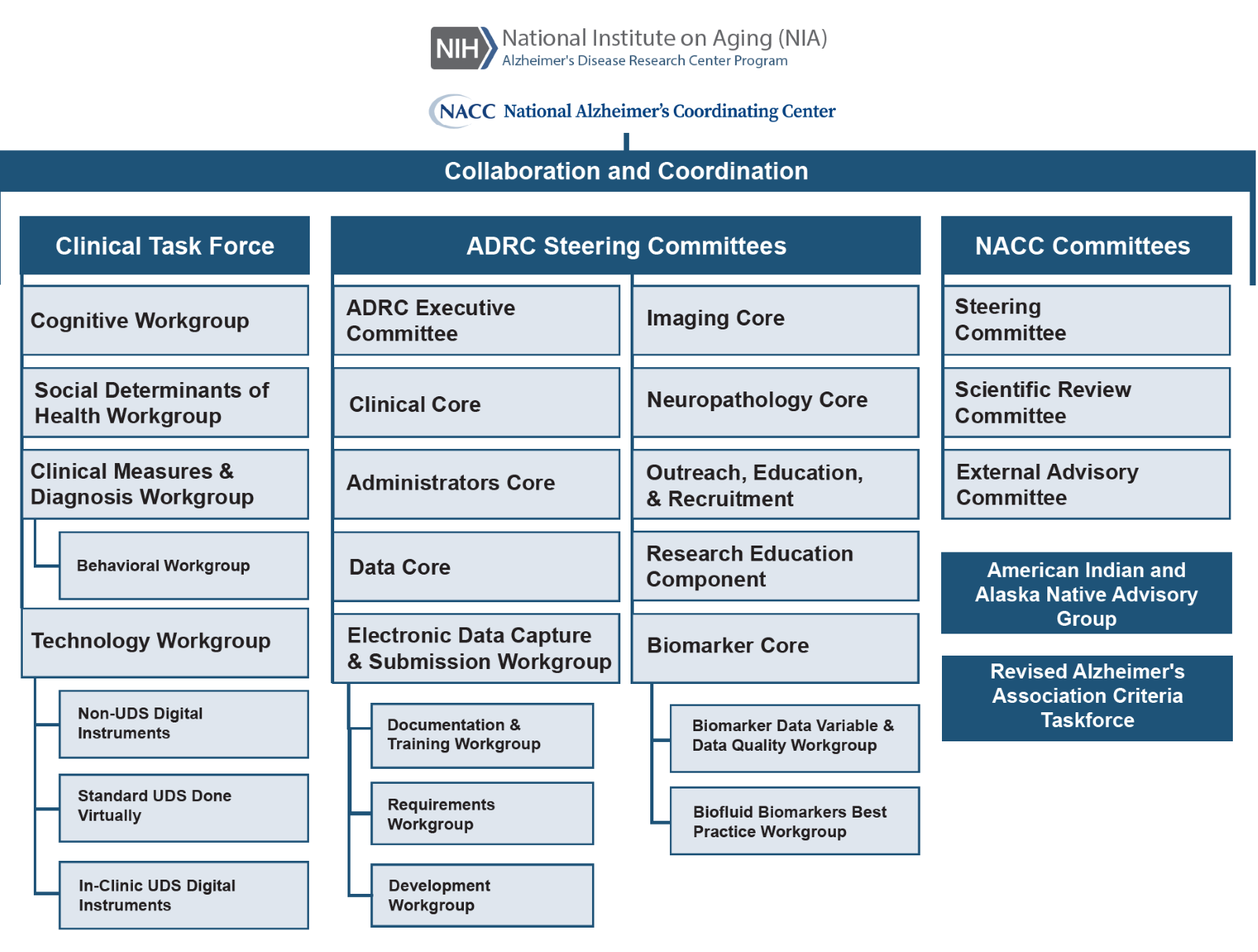
NACC partners with multiple steering committees to drive forward Alzheimer's disease research. NACC ensures effective leadership and continuity by managing Core Leader and special committee elections, maintaining nomination records, and overseeing rosters and rotation schedules. These committees, often associated with the ADRCs, concentrate on specific scientific domains and operational priorities. They collectively provide the structural and scientific framework necessary for the ADRC Program to fulfill its mission of advancing AD/ADRD research. Each committee plays a unique but interconnected role, ensuring that the program operates efficiently and continues to generate high-impact contributions to the field.
Purpose: Provides overarching leadership and strategic direction for the ADRC network, ensuring the centers operate cohesively and effectively to meet the goals of advancing Alzheimer’s disease research. This committee shapes the long-term vision for the ADRCs, aligning their objectives with the priorities of the National Institute on Aging (NIA) and the broader scientific community. It fosters collaboration between centers, encouraging innovative, multidisciplinary research efforts and ensuring that resources are strategically allocated.
Responsibilities: Oversees center activities, sets research priorities, and ensures alignment with National Institute on Aging (NIA) goals.
Purpose: Directs the operations and strategic initiatives of the National Alzheimer’s Coordinating Center (NACC), ensuring that its activities align with the needs of the ADRCs and the broader research community. This committee plays a critical role in maintaining the infrastructure for data collection, integration, and sharing across the ADRC network, while also identifying opportunities to enhance NACC’s services and expand its impact.
Responsibilities: Oversees NACC’s data management systems, sets priorities for resource development, and evaluates the effectiveness of ongoing initiatives. This committee works closely with ADRC leadership to address emerging needs in Alzheimer’s research and adapt NACC’s support structures accordingly.
Purpose: Plays a central role in establishing and maintaining the clinical foundation of the ADRC network. By focusing on the design and implementation of clinical research protocols, this committee ensures that studies across ADRCs are methodologically sound and harmonized. This is vital for collecting high-quality, standardized clinical data that can be used to explore disease progression, evaluate therapeutic interventions, and develop diagnostic tools.
Responsibilities: Develops standardized clinical protocols, ensures consistent data collection, and addresses challenges in clinical research.
Purpose: Biomarkers are critical for understanding disease mechanisms, diagnosing Alzheimer’s disease, and tracking disease progression. This committee works to advance biomarker research by identifying novel biomarkers and ensuring that their collection, analysis, and integration are consistent across centers. Their efforts help bridge the gap between basic science and clinical applications, enabling earlier and more accurate diagnosis and informing personalized treatment approaches.
Responsibilities: Promotes biomarker discovery, standardizes collection and analysis, and integrates findings into clinical studies.
Purpose: Supports the operational backbone of the ADRC program. By focusing on administrative challenges, this committee ensures that the centers function smoothly and efficiently. It facilitates the exchange of best practices in financial management, regulatory compliance, and resource allocation, enabling the research teams to focus on their scientific goals. This committee also ensures that ADRCs meet their reporting requirements and stay aligned with federal guidelines.
Responsibilities: Shares best practices, addresses operational challenges, and ensures efficient resource management.
Purpose: Dedicated to building the next generation of researchers in Alzheimer’s and related dementias. By fostering education, mentorship, and professional development, this committee helps address the growing need for scientists trained to tackle the complex challenges of neurodegenerative diseases. It encourages individuals from underrepresented backgrounds to enter and thrive in the field. Their work ensures a sustainable pipeline of talent to carry forward Alzheimer’s research.
Responsibilities: Offers career development opportunities and supports training initiatives.
Purpose: Neuroimaging is a cornerstone of modern Alzheimer’s research, providing insights into the structural and functional changes in the brain. This committee oversees the development and refinement of imaging protocols to ensure high-quality, standardized data collection across ADRCs. By promoting the use of imaging technologies such as MRI and PET, the committee facilitates research into disease progression, early detection, and the effects of potential therapies.
Responsibilities: Develops imaging protocols, ensures data quality, and promotes imaging for Alzheimer’s understanding.
Purpose: Focuses on the postmortem study of brain tissue, a gold standard for understanding Alzheimer’s disease pathology. This committee standardizes tissue collection and analysis protocols to ensure consistency across centers. Their efforts support groundbreaking research into the cellular and molecular underpinnings of Alzheimer’s and related dementias, providing a foundation for developing new diagnostics and therapies.
Responsibilities: Standardizes tissue collection and analysis, supports studies, and facilitates data sharing.
Purpose: Works to strengthen community engagement and expand participation in Alzheimer’s research. This committee develops outreach strategies, promotes educational initiatives, and enhances recruitment efforts to ensure robust participation across the research network.
Responsibilities: Develops outreach strategies, promotes educational initiatives, and increases participation.
Purpose: Ensures the integrity, accessibility, and utility of the vast amounts of data generated by the ADRCs. This committee develops robust data collection protocols and oversees quality control processes to ensure data is reliable and standardized. By supporting advanced statistical analyses and facilitating data sharing, this committee accelerates the pace of discovery and enhances the reproducibility of research findings.
Responsibilities: Oversees data collection protocols, ensures quality control, and supports statistical analysis to advance discoveries.
Purpose: Provides expert evaluation of proposed research initiatives, ensuring that studies conducted within the ADRC network are scientifically rigorous, feasible, and aligned with the program’s mission. This committee fosters innovation while maintaining the highest standards of research integrity.
Responsibilities: Reviews research proposals, provides constructive feedback, and prioritizes projects that align with NIA and ADRC goals. The committee also identifies gaps in existing research and advises on emerging opportunities to enhance the impact of ADRC-supported studies.
Alzheimer’s Disease Research Centers Groups
NACC collaborates with dedicated workgroups to advance AD/ADRD research and improve data collection methodologies. These workgroups, composed of experts from the ADRCs, focus on specialized areas to refine research practices and establish consistent standards. By fostering collaboration and integrating the latest scientific advancements, these workgroups are essential to NACC’s mission of supporting high-quality, standardized data collection across the Alzheimer’s research community.

Clinical Task Force (CTF) and Specialized Workgroups
Purpose: Guide the development and ongoing refinement of the Uniform Data Set (UDS), ensuring it evolves to incorporate the latest scientific and clinical knowledge.
Responsibilities: The CTF partners with NACC to establish strategic objectives, set priorities, and oversee the delivery of key initiatives. Within this framework, specialized workgroups focus on targeted areas such as electronic data capture (EDC) workflows and the implementation of UDS version 4 (UDSv4). These workgroups address technical and operational challenges to ensure that data collection remains efficient, reliable, and aligned with research priorities.

Electronic Data Capture (EDC) Workgroup
Purpose: Drive the transition from paper-based data collection to modern electronic systems across the ADRCs.
Responsibilities: This workgroup develops streamlined EDC workflows, provides comprehensive training and technical support for ADRC staff, and ensures data accuracy and security during the transition. By modernizing data capture methods, the EDC Workgroup enhances efficiency, reduces errors, and positions the ADRC network for long-term success in managing complex data.

Biomarker Workgroups
Purpose: Develop standardized guidelines for the collection, processing, and analysis of fluid biomarkers across the ADRC network to ensure data consistency and reliability.
Responsibilities: These workgroups establish protocols that harmonize biomarker data collection, enabling cross-center collaboration and improving the comparability of findings. Their efforts support critical research into the biological mechanisms of Alzheimer’s disease and help accelerate the discovery of new diagnostic tools and therapeutic targets.

American Indian and Alaska Native AD/ADRD Data Sovereignty Advisory Group
Purpose: Advocate for the respectful collection, management, and use of data from Indigenous populations participating in Alzheimer’s and related dementias research.
Responsibilities: This advisory group works to ensure that data sovereignty principles are upheld, including the protection of cultural and community interests. It advises on the development of culturally sensitive research protocols, supports the meaningful inclusion of Indigenous perspectives, and fosters partnerships with Indigenous communities to promote trust and collaboration.